

For fleet managers and ship owners, the digitalisation conversation is completely changing.
Now, the question is not simply about whether they should invest in digital technology; it is more about what will actually improve or how will they measure it?
A new platform, AI tool or dashboard does not just create value on its own. The return will only start when technology will make everyday fleet operations easy to manage, maintenance decisions improve, when teams find information faster, technical issues are addressed faster across vessels.
This is where fleet digitalisation becomes a business case rather than simply remaining a technological project.
Hence, we can say that it is not just a technology; the real return is faster actions, less wasted time, fewer disruptions and better control across the fleet.
Digitalisation That Has More Than “Go Digital”
Fleet digitalisation is about connecting technology, practical workflows and trusted data to improve shore operations and vessel operations. It can cover Vessel IT and connectivity, maintenance data, inventory and spare-parts management, Planned Maintenance Systems (PMS), analytics, remote support, digital inspections, predictive maintenance, workflow automation and AI-enabled decision support. But the goal is not to digitise everything. The goal is to make the operation more reliable, visible and controllable.
That direction is increasingly reflected across the maritime industry. In March 2026, International Maritime Organization (IMO) approved the IMO Strategy on Maritime Digitalization, highlighting interoperability, system standardisation, data sharing and effective data governance. The Strategy will undergo further review before being submitted for adoption by the IMO Assembly in 2027.
Where the Money Comes Back
The ROI of maritime digitalisation rarely appears as one dramatic saving. It builds through improvements that happen on a day-to-day basis across vessels, processes and teams.
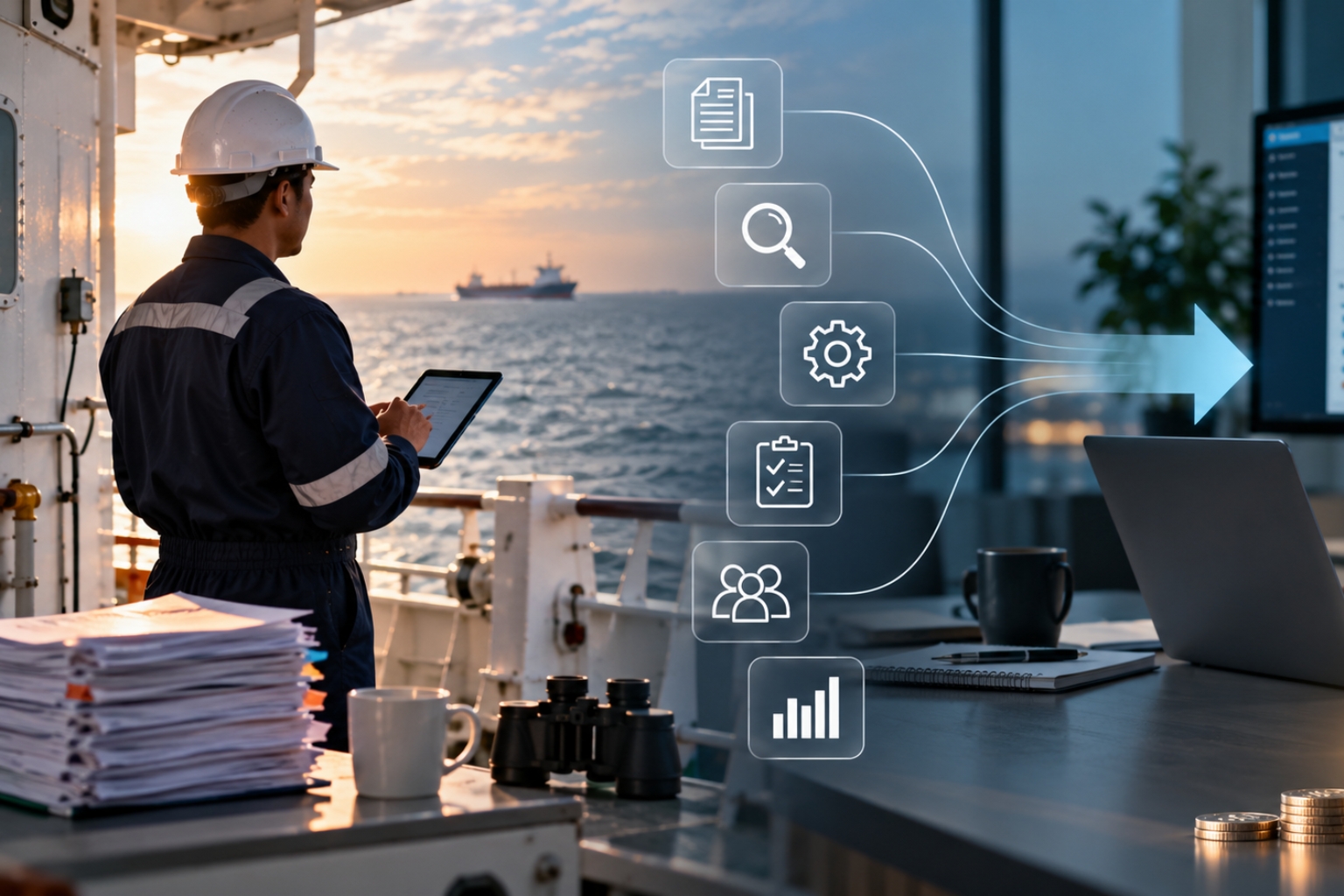
1.Stop Paying for Unnecessary Work
Fleet operations involve countless hours of checking, following up, searching and re-entering information. Documents need to be found, equipment histories have to be checked, inventory reconciled, maintenance needs a follow-up and reports need preparation. Individually, all these tasks may look insignificant, but across a fleet they consume valuable superintendent, engineering, crew and shore team time.
Digital workflows can bring down that friction by making information easy to capture, validate, find and share. The real question is not how much digitalisation has happened, but it is how much unnecessary work was removed.
The wider maritime sector provides a useful illustration. World Bank research on Port Community Systems has shown how efficient information exchange can reduce operational inefficiency and administrative activity.
2.Transform Data Into Decisions
Shipping does not have a shortage of data. It has a challenge in getting useful information to the right person at the right time. When equipment history, maintenance records, defects, technical documentation and spare availability are scattered across multiple systems, spreadsheets and emails, a technical problem can become an information problem also.
Effective maritime digitalisation will bring down the journey from problem to information to decision to action. This is where the actual value lies, not in collecting just data but in making existing information highly useful. And there is one essential foundation: data quality. No dashboard, analytics platform or AI model can consistently deliver reliable insight with unreliable information.
3.Take the Pressure Off Downtime
When a vessel is disrupted, the impact does not only remain limited to the repair. Lost operating time, schedule disruption, additional technical intervention and urgent procurement will all add up to the exposure.
Digitalisation will not eliminate every failure. It can, however, help teams identify those issues earlier, access technical information faster so that planned maintenance can happen effectively through coordinated responses.
That is one reason predictive maintenance in shipping continues to attract more and more attention. Recent research into telemetry-based digitalisation found measurable improvements in spare-part cost and maintenance, as well as Port State Control outcomes, within the fleet studied.
The lesson is not that every fleet will achieve the same kind of result. It is that digitalisation will be measured against the defined operational baseline.
4.Make Maintenance Data Work Harder
A PMS is only as useful as the information that is behind it. Inconsistent equipment structures, duplicate jobs, weak equipment-to-spare relationships and outdated records will make maintenance planning harder and will also reduce confidence in the system.
Improving the underlying data will change the chain. When there is clean data, there will be better visibility, better planning and better readiness.
Digital transformation in shipping does not always mean just buying one platform. It actually means the biggest opportunity is to make the systems and information already in place work in such a way that they become more reliable.
5.See the Fleet, Not Only the Vessel
One vessel has a recurring defect that becomes an issue. Five vessels showing the same pattern — now you have a fleet-level insight.
With stronger maritime data analytics and connected fleet management, shore teams will be able to compare maintenance trends, recurring defects, spare consumption, maritime incidents and inspection observations across vessels.
The objective is not another dashboard. It is seeing the pattern early enough to act earlier. This is when vessel data becomes fleet intelligence.
6.Prove the Payback, Stop Assuming It
A credible digitalisation business case starts with the baseline. Before implementation, understanding the current cost in terms of:
- Maintenance effort
- Unplanned downtime
- Staff and crew time
- Emergency procurement
- Data reconciliation
- Manual reporting
- Decision-making delays
- Compliance preparation
Then measure the same areas after implementation. A simple starting point is:
Digitalisation ROI = Measurable annual benefit − annual digitalisation cost
The strongest business case is not just having a promised percentage. It is a clearly defined operational gap, credible baseline and also evidence that the vessel operation has considerably improved.
7.The Real Return Is Better Operations
Fleet digitalisation pays back when better information and better technology will translate into better execution and better decisions:
- Less administrative effort
- Faster technical responses
- Better maintenance planning
- Lower downtime exposure
- Stronger ship–shore coordination
- Clear fleet visibility
Hence, the question is not how much technology has been deployed. It is what got better after the deployment took place. This is where maritime digitalisation moves from just becoming a technological investment to a measurable operational advantage.
Find Where Your Fleet Can Improve
Every fleet has different systems, operational gaps and processes. The first step is to understand where information, time, reliability or control is being lost.
Start with the Digital Operations Assessment from PiscesER1 Marine to identify improvement opportunities across Vessel IT, inventory, maintenance data and digital workflows — and build a practical roadmap around measurable outcomes.
Explore your fleet’s digitalisation opportunities!